AI book cover generator for a front-cover concept
Create a portrait visual direction for the front cover from text, test the genre signal and thumbnail read, then finish exact title, author name, spine, back cover, bleed, and print settings in a layout tool.
Kanvora does not create a full print wrap, spine, back cover, KDP upload, bleed file, editable title type, ISBN block, or print-on-demand listing.
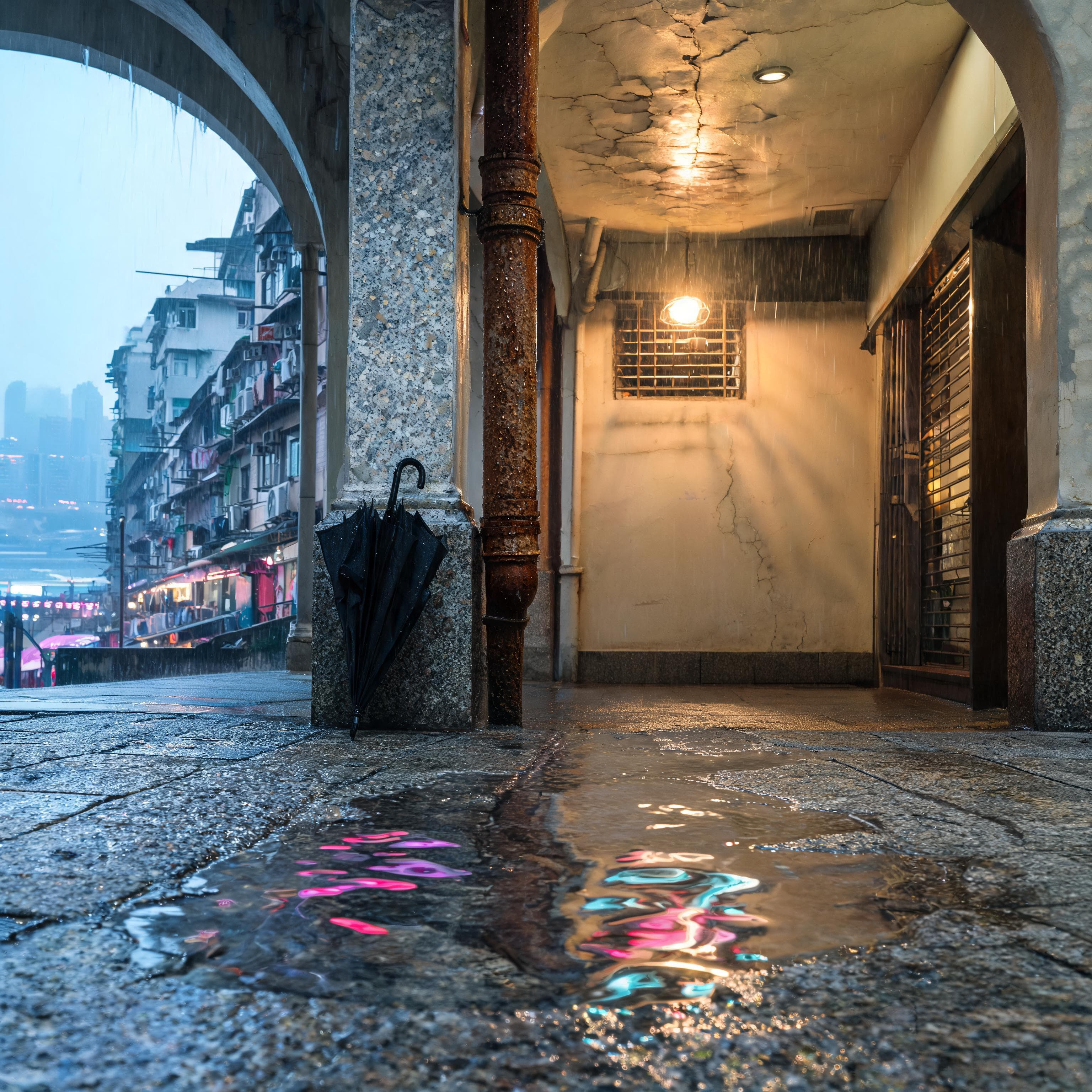 AI-generated · Kanvora official
Photoreal cinematic still of an empty rain-wet Mid-Levels stone arcade just after dusk, Hong Kong. Square 1:1. No people, no faces, no shop names. Foreground materials: pitted granite pavement with a shallow rain sheet; magenta, amber, and cool-cyan neon from the far harbour swim across the puddle as broken ribbons, not as type. A rusted iron downpipe beads with dense condensation; mineral sparkle in the wet stone; one forgotten black nylon umbrella leaning against a chipped terrazzo column, fabric darkened by rain. Mid-ground: a vaulted covered walkway, peeling cream plaster with hairline cracks, a single tungsten shop-light still on behind a metal grille, wet tiles catching the bulb as long speculars. Humid volume light hangs in the vault. Far: through the arcade mouth, a layered urban canyon, laundry poles, rusted air-conditioner units, the harbour reduced to a dark lead strip of light in thin mist. No readable signage. Light: low-kelvin tungsten in the vault as the key, distant magenta neon bounce, a thin moon-blue skylight mixing into humid air. Shadows stay attached to the column and the downpipe. Atmosphere: rain, thin mist, no fog bank that hides the vault. Lens: 35mm, f/2.0 falloff, slight low angle, focus on the puddle and the downpipe droplets, background lights as soft bokeh. Restrained palette: rust, tungsten, cyan, granite gray. Must avoid: people, faces, readable signage, logos, watermarks, poster layout, extra architecture that hides the arcade vault, added props.
Kanvora official model output example, not a finished or print-ready book cover.
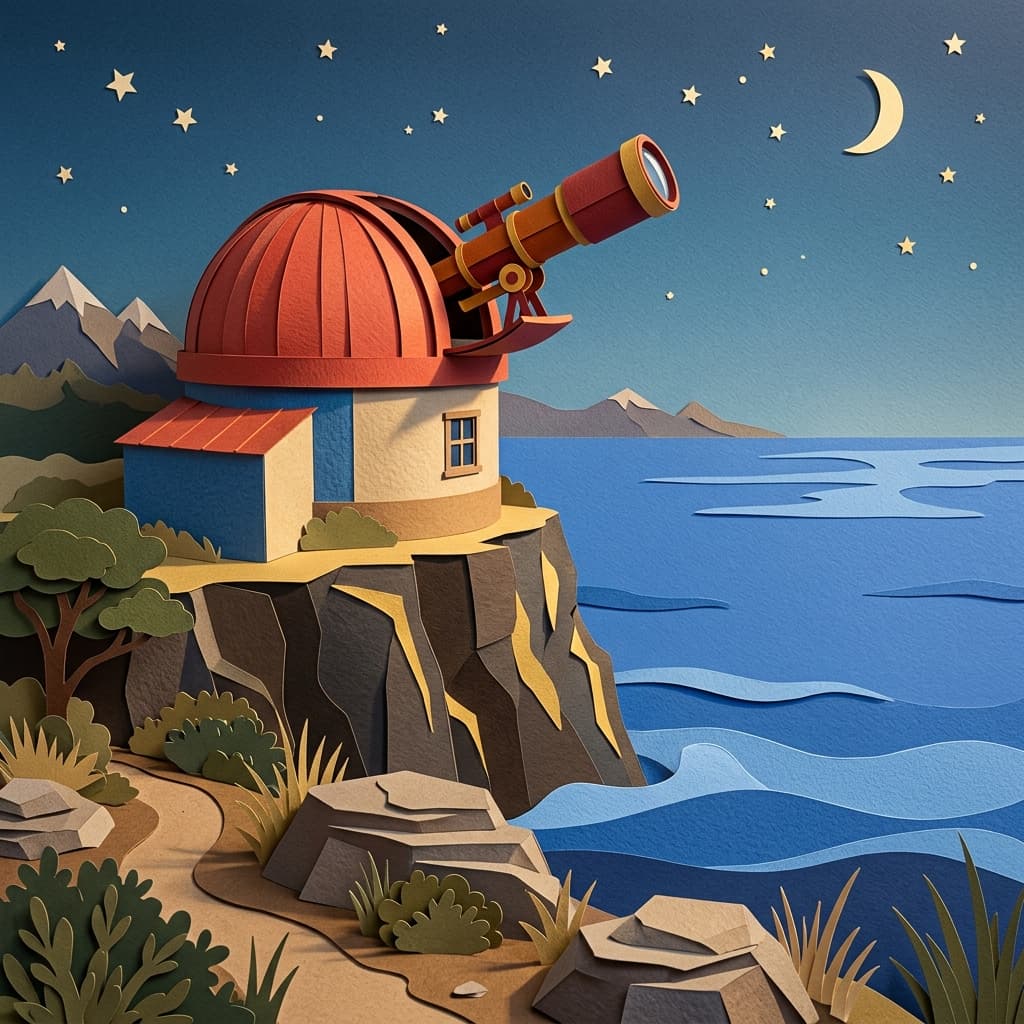 AI-generated · Kanvora official
A tactile cut-paper observatory above a calm cobalt ocean, vermilion telescope, precise golden shadows, no people
Kanvora official model output example, not a finished or print-ready book cover.
Use the diagram as a review guide
Genre signal, title zone, and a clear thumbnail read without pretending the print wrap is complete.
Write the cover's visual job before its style
The cover must signal the right reading experience and leave room for exact typography.
Summarize the book honestly, choose one visual premise, and decide what a reader should infer at thumbnail size. Keep exact title and author text as a later layout responsibility whenever spelling and type control matter.
- Book promise: one sentence describing the real reading experience without plot or outcome inflation.
- Genre signal: the visual cues that should place the book near the correct shelf, without copying another cover.
- Central premise: one scene, object, or abstract relationship rather than a montage of plot points.
- Title zone: reserve a quiet upper, middle, or lower region for editable type.
- Palette and treatment: describe light, materials, edges, and color roles that support the premise.
- Exclusions: author likeness, existing cover art, franchise marks, tiny copy, blurbs, ISBNs, and watermarks.
Prompt for a front-cover visual, not a fake print file
Separate the visual premise from the exact title and production information that will be added later.
A restrained prompt gives the model room to establish one memorable image while preserving a clear title zone. It also makes the result easier to reject when genre, subject, or rights boundaries fail.
Book promise: [one truthful sentence about the reading experience]
Genre signal: [two or three visual cues]
Central visual premise: [one scene, object, or abstract relationship]
Composition: portrait 3:4, reserved title zone at [top | middle | bottom]
Palette and treatment: [light, color roles, material or illustration approach]
Must include: [two reviewable details]
Must avoid: title text, author name, blurbs, ISBN, existing cover art, franchise marks, watermarksField guide to overlooked city trees
This example demonstrates input structure only. Replace every detail with a brief you are allowed to use.
Book promise: an observant nonfiction guide to recognizing overlooked urban trees
Genre signal: precise field-guide detail, quiet discovery, practical natural history
Central visual premise: one leaf silhouette revealing a street map through its veins
Composition: portrait 3:4, large leaf centered low, calm title zone across the upper third
Palette and treatment: deep green, warm paper, cobalt map lines, crisp printmaking texture
Must include: one recognizable leaf edge and one subtle street-grid relationship
Must avoid: title text, author name, skyline collage, people, existing cover art, logos, watermarks
Choose 3:4, then review at thumbnail size
A portrait raster can establish the front-cover direction but not the complete print geometry.
Use 3:4 as the live Kanvora portrait frame for concepting. The final trim ratio, spine width, bleed, and full-wrap dimensions must come from the actual printer or publishing platform.
| Need | Choose | Check before generating |
|---|---|---|
| Front-cover concept | 3:4 | Reserve a clear title zone and keep the central premise readable at thumbnail size. |
| Fast composition review | Nano Banana 2 1K, 4 credits | Judge premise, genre signal, and title space before larger output. |
| Larger raster reference | Seedream 5.0 Lite 2K at 3 credits or Nano Banana 2 2K at 5 | Use for visual development, not as a print-ready wrap. |
| Exact title and author | Layout tool required | Typeset every character with an editable font and real rights. |
| Spine and back cover | Not generated here | Calculate from final trim, page count, paper, printer, and platform requirements. |
Kanvora's 3:4 frame is a creative starting point, not an assertion about current KDP or printer specifications.
Take a cover concept from brief to layout handoff
Generation owns the visual premise; the production file owns exact text and print geometry.
Review the concept for genre, premise, title space, rights, and thumbnail read before spending time on typography or print setup.
- 1
Lock the book promise and genre signal
Write one honest promise, one central visual premise, title-zone location, palette, and exclusions.
ContinueA reviewer can explain how the image relates to the actual book.Stop or reviseThe concept depends on copying an existing cover, franchise, or artist style too closely. - 2
Build a text-free 3:4 prompt
Describe the front-cover image and reserve space for exact title and author text later.
ContinueThe prompt can succeed without generated lettering or a fake print wrap.Stop or reviseMove blurbs, ISBN, spine, and back-cover copy into the production layout. - 3
Choose model and generate once
Select the displayed 3, 4, or 5-credit path, sign in, and submit one portrait request.
ContinueOne concept enters the queue and one credit hold is visible.Stop or reviseDo not duplicate an active or UNKNOWN request. - 4
Review premise and thumbnail read
Check genre signal, focal subject, title zone, unintended text, rights risk, and whether the premise survives a small preview.
ContinueThe visual communicates the book honestly at both review scales.Stop or reviseReject misleading, derivative, crowded, or text-dependent output. - 5
Hand off to production layout
Download the stored visual, add exact type, and build the full print or ebook file from real destination specifications.
ContinueThe production owner has the visual, review notes, trim source, and exact copy.Stop or reviseDo not upload the raw generated raster as a complete wrap without production checks.
Review a cover that signals the wrong book
A beautiful image fails when it attracts readers with the wrong genre promise.
The rehearsal treats genre and book truth as pass conditions, not subjective decoration.
Urban-tree field guide cover rehearsal
Fix cover failures before typography and print setup
Correct the visual premise first so production work is not built on the wrong promise.
Keep passing genre and composition choices while revising the one failed relationship. Use the layout file, not another generation, for exact title corrections.
- Wrong genre signal
- Name two or three observable cues from the actual reading experience and remove conflicting cinematic tropes.
- Title zone is crowded
- Move the focal subject, simplify background detail, and reserve one quiet region explicitly.
- Generated title is wrong
- Exclude all title and author text, then typeset exact copy in a layout tool.
- Cover feels derivative
- Reject it, document the similarity, and change the central premise rather than polishing surface style.
- Image fails as a thumbnail
- Simplify to one larger premise, stronger value separation, and fewer small details.
- Queue status is UNKNOWN
- Wait for the original submission to settle instead of creating a second cover request.
Budget the visual premise before the print file
Generation credits do not cover typography, rights review, or platform production work.
Set a concept-round limit and stop once the visual premise passes. Exact title changes, spine calculations, back-cover layout, bleed, and export checks belong to the production file and should not trigger another image generation.
| Model setting | Credits per attempt | Use when |
|---|---|---|
| Seedream 5.0 Lite 2K | 3 | You want the lowest current credit cost and a 2K still. |
| Seedream 4.5 2K | 4 | You need Seedream 4.5 text-to-image at its fixed live output. |
| Nano Banana 2 1K | 4 | You want the Kanvora default and 1K is enough for the review round. |
| Nano Banana 2 2K | 5 | You need Nano Banana 2 at the larger live output setting. |
| Seedream 5.0 Pro 1K | 6 | You need the flagship Seedream text-to-image path at its fixed live size. |
The 20-credit signup grant supports several deliberate concept reviews. Kanvora does not charge for or perform KDP upload, printer setup, ISBN handling, or print-on-demand store management.
Move from cover concept to production layout
A stored 3:4 raster is a front-cover input, not a complete book package.
Stop generating when the premise, genre, title zone, and thumbnail read pass. Continue in a layout workflow using the final destination's real specifications.
- Generate the visual premise
- A text-only portrait concept can express the book without exact embedded copy.
- Revise the premise
- Genre, subject, title space, rights boundary, or thumbnail recognition failed.
- Wait for the current job
- The request is active or UNKNOWN and should not be submitted again.
- Use a layout tool
- The front image passes and now needs exact title, author, series, and production type.
- Use real platform specs
- Trim, spine, back cover, bleed, color, and export depend on the actual publisher or printer.
- Keep the current concept
- The visual accurately signals the book and leaves a usable title zone.
Final review checklist
- The central visual premise matches the actual book and genre.
- The front-cover concept survives a small thumbnail preview.
- No existing cover, franchise mark, unchecked title, or unowned likeness appears.
- Exact title, author, spine, back cover, bleed, and export are assigned to layout.
- The stored visual and review notes download before production begins.
Sources and review date
Model, product, queue, and credit facts can change and should be checked after the review date.
Kanvora's generator and registry establish only the live raster models, ratios, and credits. They do not establish publishing-platform dimensions, rights clearance, print readiness, or title accuracy. Those high-change and production facts stay with the actual layout and publishing workflow.
- Google AI: Nano Banana 2 API image generation documentation.
- ByteDance: Seedream 5.0 Lite model page.
- fal: Seedream 5.0 Lite text-to-image endpoint and Seedream 4.5 text-to-image endpoint.
- Kanvora: Live generator, pricing, Acceptable Use Policy, Terms, and Privacy.
Last verified: August 20, 2026. Frozen PAP review due: November 20, 2026.
Find the cover premise. Finish the book properly.
Generate a reviewed 3:4 visual direction, then carry the stored file into a real typography, rights, and production workflow.